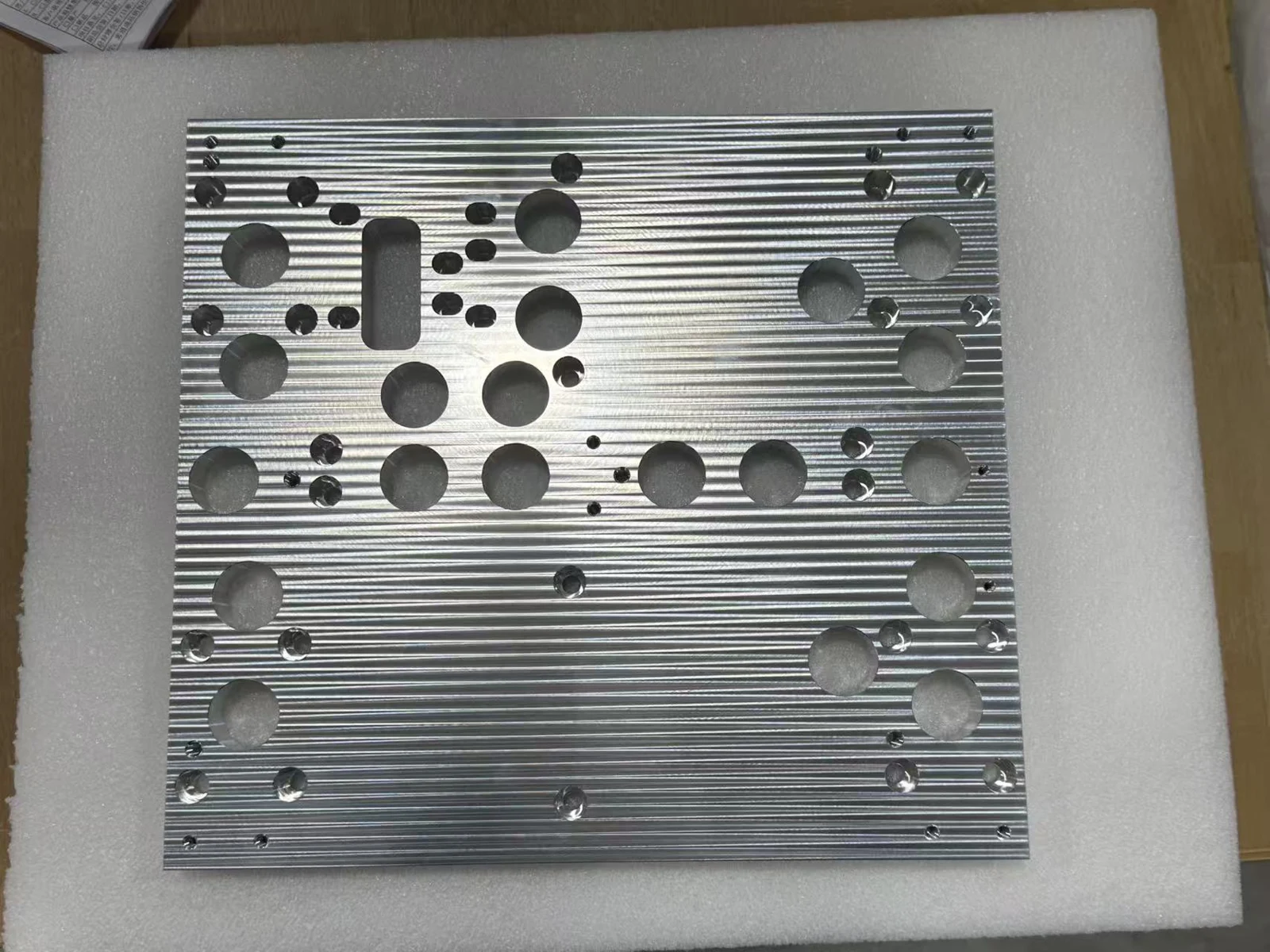
Complex pockets and dense hole patterns demand careful control of fixturing and distortion. Low-stress clamping, cryogenic treatment after roughing and staged inspection shape the process around the drawing.
Industry
Semiconductor
Material
Per project drawing
Finish
Per project specification
Quantity
Confirmed per project
Drawings retain their original annotations.
01PRODUCT PHOTOGRAPHS
Product photographs
Product photographClick to enlarge ↗02TECHNICAL REQUIREMENTS
Machining challenges
Technical drawingClick to enlarge ↗01
A 0.005 mm parallelism tolerance that is hard to achieve
The drawing requires 0.005 mm parallelism relative to datum A. A large share of material is removed from the plate, with many pockets and holes, which greatly reduces its stiffness. Conventional strap clamping introduces clamping stress that is released when the clamps are removed, warping the plate. Cutting heat also expands the plate, and once it cools the parallelism goes out of tolerance. Holding micron-level parallelism consistently demands a great deal from the whole machining system.
02
Distortion risk from high material removal
The part has many channels and dense holes, and heavy milling triggers the release of residual stress. Stress left after roughing keeps releasing slowly after finishing and unclamping, so a part that measures correctly during machining can go out of parallelism after standing for a while.
03
Mixed features and demanding tool conditions
One plate combines large-face milling, deep channel milling, counterbores, pin holes and through-holes. Face milling over a large area alongside deep milling of narrow closed channels means tool overhang varies widely, causing deflection and chatter. Machining faces, pockets and holes in turn builds up heat, which adds to the distortion.
04
The machining environment affects final accuracy
Micron-level tolerances are very sensitive to ambient temperature. Temperature differences make the aluminium plate expand and contract, directly causing measurement and machining errors, and a normal workshop environment cannot hold this accuracy reliably.
03PROCESS AND INSPECTION
Process solutions
01
Optimised fixturing to remove clamping stress
Instead of rigid strap clamps, low-stress fixturing minimises forced distortion from clamping, prevents local twisting of the plate and keeps spring-back controlled when the part is released.
02
Stress stabilisation by cryogenic treatment
A cryogenic treatment step after roughing fully releases residual stress and stabilises the microstructure, preventing later ageing distortion from stress released after machining and locking in the part's dimensions and flatness.
03
Tools and cutting parameters matched to each feature
Tools are selected for the large faces and the closed channel pockets. Feed, speed and depth of cut are optimised, with layered cutting and light finishing passes, to reduce cutting force and heat input, suppress chatter and deflection, and limit thermal distortion.
04
A controlled machining environment
Machining takes place in a temperature-controlled environment to reduce micron-level errors from thermal expansion of the aluminium, and both machining and inspection are completed under controlled conditions.
05
Geometric tolerance inspection at every stage
Parallelism is measured after roughing, after cryogenic treatment and after finishing, checking the face against datum A to make sure the finished part meets the 0.005 mm parallelism requirement.
Technical parameters and processes follow the project documentation. The drawing governs technical requirements; acceptance results follow project inspection records.
A 0.005 mm parallelism tolerance that is hard to achieve
The drawing requires 0.005 mm parallelism relative to datum A. A large share of material is removed from the plate, with many pockets and holes, which greatly reduces its stiffness. Conventional strap clamping introduces clamping stress that is released when the clamps are removed, warping the plate. Cutting heat also expands the plate, and once it cools the parallelism goes out of tolerance. Holding micron-level parallelism consistently demands a great deal from the whole machining system.
02
Distortion risk from high material removal
The part has many channels and dense holes, and heavy milling triggers the release of residual stress. Stress left after roughing keeps releasing slowly after finishing and unclamping, so a part that measures correctly during machining can go out of parallelism after standing for a while.
03
Mixed features and demanding tool conditions
One plate combines large-face milling, deep channel milling, counterbores, pin holes and through-holes. Face milling over a large area alongside deep milling of narrow closed channels means tool overhang varies widely, causing deflection and chatter. Machining faces, pockets and holes in turn builds up heat, which adds to the distortion.
04
The machining environment affects final accuracy
Micron-level tolerances are very sensitive to ambient temperature. Temperature differences make the aluminium plate expand and contract, directly causing measurement and machining errors, and a normal workshop environment cannot hold this accuracy reliably.
03PROCESS AND INSPECTION
Process solutions
01
Optimised fixturing to remove clamping stress
Instead of rigid strap clamps, low-stress fixturing minimises forced distortion from clamping, prevents local twisting of the plate and keeps spring-back controlled when the part is released.
02
Stress stabilisation by cryogenic treatment
A cryogenic treatment step after roughing fully releases residual stress and stabilises the microstructure, preventing later ageing distortion from stress released after machining and locking in the part's dimensions and flatness.
03
Tools and cutting parameters matched to each feature
Tools are selected for the large faces and the closed channel pockets. Feed, speed and depth of cut are optimised, with layered cutting and light finishing passes, to reduce cutting force and heat input, suppress chatter and deflection, and limit thermal distortion.
04
A controlled machining environment
Machining takes place in a temperature-controlled environment to reduce micron-level errors from thermal expansion of the aluminium, and both machining and inspection are completed under controlled conditions.
05
Geometric tolerance inspection at every stage
Parallelism is measured after roughing, after cryogenic treatment and after finishing, checking the face against datum A to make sure the finished part meets the 0.005 mm parallelism requirement.
Technical parameters and processes follow the project documentation. The drawing governs technical requirements; acceptance results follow project inspection records.